Urban and Community Forests
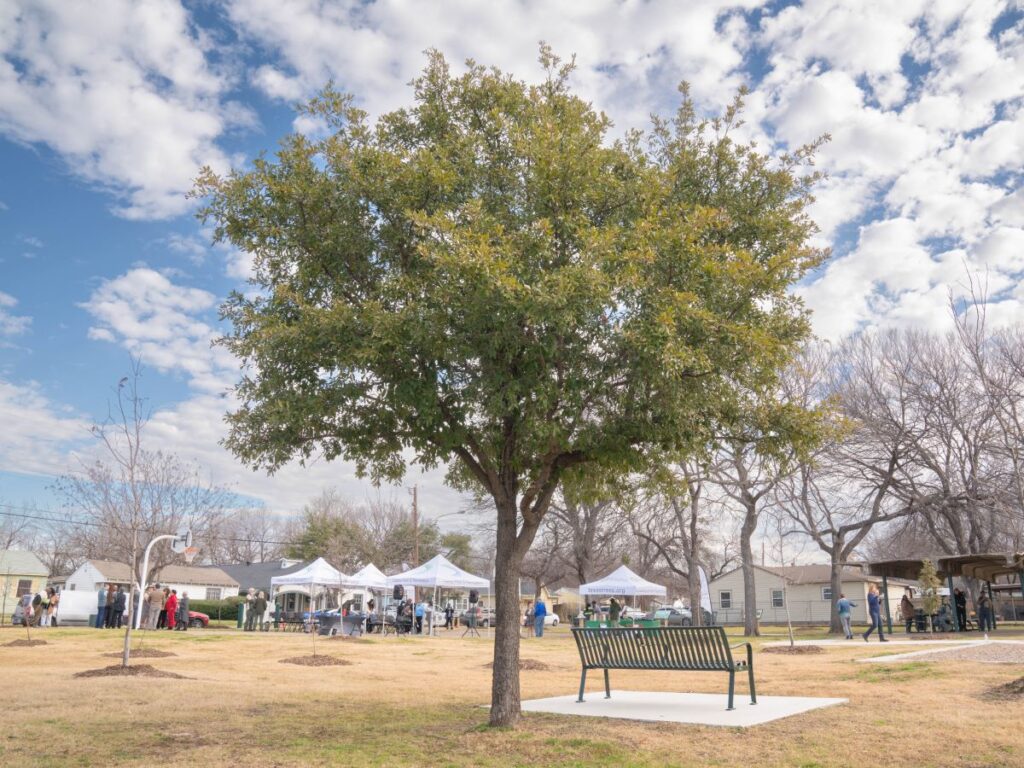
All Resources on Urban and Community Forests
-
Texas A&M Forest Service is offering over $1.2 million in grant funding through the Community Forestry Grants program to enhance community forestry initiatives throughout the state.
-
Community Forestry Grant Request for Proposals
Publication
-
Community Forestry Grants Guidance Document 2026
Publication
The Guidance Document is a manual developed and created to support applicants interested in Texas A&M Forest Service Community Forestry Grants. -
This worksheet is to help you prepare your application and finalize your answers. This is NOT a submittable document.
-
Eighteen Texas municipalities, schools and non-profit organizations were awarded grant funding through Texas A&M Forest Service’s Community Forestry Grants program this month, totaling over $4 million. Established in 2022, the Community Forestry Grants program provides funding to help Texans address local challenges through urban forestry investments and develop nature-based solutions that support healthier, more resilient […]
-
Urban and Community Forestry
Publication
Texas’ urban areas have experienced significant growth, resulting in tree loss, but the Texas A&M Forest Service (TFS) has been working to enhance urban forests through sustainable programs, training, and disaster response efforts, recognizing the critical economic, environmental, and social benefits of urban trees. -
Texas Statewide Assessment of Urban Forests Ecosystem Services
-
Self-Guided Forest & Nature Therapy Fact Sheet
Publication
Self-Guided Forest & Nature Therapy Fact Sheet -
Tree City USA Expense Sheet
Publication
-
Shaded Re-LEAF in the Rio Grande Valley
Tools & Applications
The Shaded ReLeaf Dashboard helps Rio Grande Valley communities most impacted by excessive heat. It combines geospatial satellite data, Social Vulnerability Index, and tree canopy info to guide strategic, high-impact tree planting initiatives. -
Healthy Trees, Healthy Lives Geospatial Viewer
Tools & Applications
Healthy Trees, Healthy Lives uses research to guide tree planting for better mental and physical health. Trees enhance well-being through tree-lined streets, treescapes near schools and medical facilities, and nearby greenspaces. -
i-Tree is a state-of-the-art, peer-reviewed software suite from the U.S. Forest Service that provides urban and rural forestry analysis and benefits assessment tools. Eco v6, an i-Tree program is a complete package that provides sampling and data collection protocols, mobile data collection system, summary reports, and automated processing that make estimates of the forest effects […]
-
Tree Line USA® promotes the dual goals of safe, reliable electric service and abundant, healthy trees across utility service areas. This benefits both utility companies and communities. The Arbor Day Foundation, in cooperation with the National Association of State Foresters, recognizes public and private utilities that demonstrate practices that protect and enhance America’s urban forests. Benefits Environmental responsibility Energy […]
-
Tree Campus USA® recognizes college and university campuses that Texas is leading the nation with 32 Tree Campus USA participants. Why participate? Environmental stewardship Energy conservation Trees help conserve energy by casting summer shade and blocking chilly winter winds. Strategically placed trees help conserve energy around your home or school. Stormwater control To cope with storm runoff, […]
-
Thousands of communities across the country consider their tree canopy a source of pride and continually strive to improve it. And through the Tree City USA program, they’re garnering national attention and recognition for it. Tree City USA® is an elite designation for communities that meet minimum standards set by the Arbor Day Foundation for community forestry programs. […]
-
Texas is rapidly growing. Increasing the strain on ecosystems surrounding our communities. While we need homes, roads, commercial buildings, and other infrastructure, the materials and methods used increases stormwater runoff, heat island effects, loss of habitat for various species, and decreases green space. That’s why we help communities develop sustainable, evidence-based strategies to conserve canopy […]
-
With a diverse range of ecosystems, Texas presents unique environmental challenges and opportunities. In the Rio Grande Valley, communities face issues like urban heat island effect that has serious health and safety impacts to residents. To effectively address these challenges, we’ve developed targeted initiatives for the Valley. Shaded ReLeaf Project Through a collaboration with the […]
-
One of the first steps in managing urban forests is to know what’s in it. Where are trees located? What are their condition, size, and species? All questions that can be answered by conducting an inventory. An essential tool for developing an urban forest management plan. There is no single, correct way of conducting an […]
-
Urban Forestry Councils are dedicated to promoting the value of urban forests. Each council is made up of community forestry experts and stakeholders from the region that work together to create programming, educational opportunities, and resources for the constituents and communities within their area. Regional councils include: These five regional urban forestry councils make up […]
-
Your urban forest likely provides millions of dollars of services a year and through developing an urban forest management plan. By developing an urban forest management plan, you can enhance and sustain those benefits. Using plan writing tools will help break the process into manageable chunks. Plan writing usually involves four key components: To […]
-
Full circle management Community wood utilization is an important part of the full circle management process. This process is the continuous improvement, service, and management of healthy urban and community forests. It uses best practices for tree care from the moment trees are planted until after they’re removed. The approach creates a sustainable and efficient […]
-
Our Community Forestry Program focuses on building local capacity to help communities develop sustainable programs that provide Texans with healthy trees and forests. Texas continues to be one of the fastest growing states in the nation. Trees provide many benefits to growing communities including improving air quality by filtering pollutants, reducing heat, and helping to […]
-
Events
-
Texas A&M Forest Service is offering $12.4 million in grant funding through the Community Forestry Grants program to enhance community forestry initiatives throughout the state.
-
Texas A&M Forest Service and the Texas Chapter of the International Society of Arboriculture (ISAT) recognized the Texas Tree Award winners at the 44th annual Texas Tree Conference in Waco, Texas, today. The Texas Tree Awards Program celebrates the accomplishments of those who have dedicated their talents to the protection, planning and proliferation of their […]
-
Trees Count
Tools & Applications
A mobile app for iOS and Android that allows users to inventory and map trees, generate reports, and transfer data across devices. Features iTree compatibility and exports data to CSV files for use in Excel. -
Tree Trails
Tools & Applications
Tree Trails is a conservation education project that enhances outdoor classrooms at schools, nature centers, and public parks by creating educational trails centered around trees, promoting environmental awareness, and learning through nature. -
Tree Risk
Tools & Applications
Helps users maps trees with obvious defects that have a probable or imminent likelihood of failure and identifies treatment. It guides through identifying hazards, helping protect communities mitigate tree-related damage. -
Urban Tree Canopy
Tools & Applications
Displays predicted urban growth areas, urban tree canopy (UTC) for selected communities, and models future UTC based on management policy. -
Tree Ordinances
Tools & Applications
The Model Public Tree Ordinance tutorial helps cities create effective public tree ordinances to achieve Tree City USA status. Download a fillable public tree care ordinance document to get started on enhancing urban tree management. -
Texas Tree Planting Guide
Tools & Applications
The Texas Tree Planting website offers resources and guidance on tree planting in Texas, including best practices, species recommendations, and site selection tips. Learn how to successfully plant and care for trees to improve your landscape. -
My City’s Trees
Tools & Applications
The My City’s Trees application enables anyone to access Urban FIA Data and produce custom analyses and reports. -
Community Forest Program Application Scoring
Publication
Scoring matrix for Community Forest and Open Space Conservation grant applications -
Community Forest Program Application Sample
Publication
Sample application to apply for Community Forest and Open Space Conservation grant -
Community Forest Program Road Map Appendices
Publication
Appendix to guide to applying for a Community Forest and Open Space Conservation grant -
Community Forest Program Road Map
Publication
Guide to applying for a Community Forest and Open Space Conservation grant -
Analysis of urban forest benefits and tree canopy
-
Urban Forestry BMPs for Public Works Managers
Publication
BMP’s designed to help public works managers effectively and proactively manage public trees -
Austin’s Urban Forest Plan
Publication
City of Austin Master Plan for urban forests and trees on public property -
Twenty-two Texas cities, neighborhoods, non-profit organizations and schools received grant funding through the Texas A&M Forest Service Community Forestry Grants Program, totaling $15.4 million.
-
More than 100 native trees were planted in College Station at Bee Creek Park and Tarrow Park this week with the assistance of the Texas A&M Forest Service Community Forestry Grants program.
-
Arlington Park Estates neighborhood, a former redlined district, remembers and thanks late Congresswoman Johnson for planting health and wellness in Dallas City Council District 2 through public park enhancements.
-
The submission window for the Texas A&M Forest Service Community Forestry Grant Program is now open and will close February 16, 2024.
-
Kendall County completes Community Wildfire Protection Plan to address community wildfire risk
News Story
Kendall County has adopted a plan to reduce risks and enhance community safety in advance of a wildfire. -
Texas Society DAR and Texas A&M Forest Service dedicate W.G. Jones State Forest Conservation Area
News Story
Texas A&M Forest Service and the Texas Society Daughters of the American Revolution (DAR) held a dedication and ribbon-cutting ceremony Sunday at the W.G. Jones State Forest Conservation Area in Conroe. -
The Texas A&M Forest Service Leadership Institute’s third cohort graduated today, following the completion of its final session in College Station.
-
Palo Pinto County has adopted a Community Wildfire Protection Plan to reduce risks and better prepare for wildfires.
-
Texas A&M Forest Service is accepting applications for a pair of $50,000 grants to promote healthy trees and forests.
-
Students from the Houston area got a chance to explore the W.G. Jones State Forest in Conroe during Texas A&M Forest Service’s “Classroom Without Walls” program.
-
Comprehensive analysis of services provided by Texas urban and community forests
-
San Antonio’s trees are working for the city
News Story
A recent census of San Antonio’s urban forest counted 137.8 million trees in and around the city that work to reduce air pollution, temperatures and stormwater runoff, while storing carbon, improving human health and just plain beautifying the Alamo City. -
Big Tree Registry
Tools & Applications
The Big Tree Registry is a list of the largest known specimens of each Texas tree species. This application displays tree measurements and photos as well as public tree locations. -
Forest and Drinking Water Connection
Tools & Applications
Story map that highlights the forest and water relationship, priority watersheds for surface drinking water supplies, and how the forest and water sectors are partnering to sustain these vital resources. -
A suspected timber thief plead guilty this week to a Second Degree Felony of Unauthorized Harvesting of Timber valued between $100,000 and $200,000. Thomas Curtis Fields, 49, of Frankston, Texas, harvested timber on private property near Jacksonville, Texas in Cherokee County without the landowner’s knowledge or permission.
-
Economic Contributions of Urban Forests in Texas
Publication
Report on the economic contribution of the urban & community forest industry in Texas -
Discover Trees and Woody Plants
Tools & Applications
Discover the trees and woody plants of Texas A&M University’s Research Park and George Bush Library areas in College Station with this visual guide. The guide lists over 35 species with one or more photos and a brief description. -
i-Tree
Publication
State of the art, peer reviewed software suite from the USDA Forest Service that provides analysis and benefit assessment tools for urban and rural forestry -
Counting on Houston’s trees
News Story
The largest city in the largest continental state in America has an urban forest to match. And now, for the first time, information about Houston’s trees is available online. The My City’s Trees web application is a free tool that makes community tree data easily accessible to the public. -
Jones State Forest Trail Map
Publication
William Goodrich Jones State Forest public use map -
Austin trees – there’s an app for that
News Story
For the first time ever, a census for trees is available in a new, easy-to-use application developed by Texas A&M Forest Service. -
The John Knox Presbyterian Camp will soon be a safer, more ecologically sound property thanks to the help of Texas A&M Forest Service. The agency will complete a habitat improvement and wildland fire fuels reduction project at the end of May. The non-profit camp, like man
-
The U.S. Forest Service published the first-ever urban forest assessment—citing the composition and health of the Austin, Texas urban forest, the benefits it provides, and documenting the contributions trees make to the environment, economy and the well-being of the community’s residents. Texas A&M
-
Going green can change the world; one community at a time. The mission to spread this message brought national recognition to the Green Ambassadors and Texas A&M Forest Service. Earlier this month, Green Ambassadors from the Latino Legacy program working on the Houston
-
Taking care of America’s lands and natural resources is a big job. No single organization can do it alone. Knowing that we are stronger together — the USDA Forest Service has entered into a Good Neighbor Authority agreement with Texas A&M Forest Service to help conserve,
-
Sabine NF
Publication
Map of Sabine national forest communities -
El Paso Community Forest Assessment (2014)
Publication
Ecosystem Services analysis of El Paso’s urban forest and tree canopy -
City of Mesquite i-Tree Eco Report (2012)
Publication
Analysis of urban forest benefits and tree canopy -
City of Midland Street Tree Inventory
Publication
Analysis of urban forest benefits and tree canopy -
Analysis of urban forest benefits and tree canopy
-
City of Pflugerville Street Tree Inventory
Publication
Analysis of urban forest benefits and tree canopy
-
Texas A&M Forest Service is offering over $1.2 million in grant funding through the Community Forestry Grants program to enhance community forestry initiatives throughout the state.
-
Eighteen Texas municipalities, schools and non-profit organizations were awarded grant funding through Texas A&M Forest Service’s Community Forestry Grants program this month, totaling over $4 million. Established in 2022, the Community Forestry Grants program provides funding to help Texans address local challenges through urban forestry investments and develop nature-based solutions that support healthier, more resilient […]
-
Texas A&M Forest Service is offering $12.4 million in grant funding through the Community Forestry Grants program to enhance community forestry initiatives throughout the state.
-
Texas A&M Forest Service and the Texas Chapter of the International Society of Arboriculture (ISAT) recognized the Texas Tree Award winners at the 44th annual Texas Tree Conference in Waco, Texas, today. The Texas Tree Awards Program celebrates the accomplishments of those who have dedicated their talents to the protection, planning and proliferation of their […]
-
Twenty-two Texas cities, neighborhoods, non-profit organizations and schools received grant funding through the Texas A&M Forest Service Community Forestry Grants Program, totaling $15.4 million.
-
More than 100 native trees were planted in College Station at Bee Creek Park and Tarrow Park this week with the assistance of the Texas A&M Forest Service Community Forestry Grants program.
-
Arlington Park Estates neighborhood, a former redlined district, remembers and thanks late Congresswoman Johnson for planting health and wellness in Dallas City Council District 2 through public park enhancements.
-
The submission window for the Texas A&M Forest Service Community Forestry Grant Program is now open and will close February 16, 2024.
-
Kendall County completes Community Wildfire Protection Plan to address community wildfire risk
News Story
Kendall County has adopted a plan to reduce risks and enhance community safety in advance of a wildfire. -
Texas Society DAR and Texas A&M Forest Service dedicate W.G. Jones State Forest Conservation Area
News Story
Texas A&M Forest Service and the Texas Society Daughters of the American Revolution (DAR) held a dedication and ribbon-cutting ceremony Sunday at the W.G. Jones State Forest Conservation Area in Conroe. -
The Texas A&M Forest Service Leadership Institute’s third cohort graduated today, following the completion of its final session in College Station.
-
Palo Pinto County has adopted a Community Wildfire Protection Plan to reduce risks and better prepare for wildfires.
-
Texas A&M Forest Service is accepting applications for a pair of $50,000 grants to promote healthy trees and forests.
-
Students from the Houston area got a chance to explore the W.G. Jones State Forest in Conroe during Texas A&M Forest Service’s “Classroom Without Walls” program.
-
San Antonio’s trees are working for the city
News Story
A recent census of San Antonio’s urban forest counted 137.8 million trees in and around the city that work to reduce air pollution, temperatures and stormwater runoff, while storing carbon, improving human health and just plain beautifying the Alamo City. -
A suspected timber thief plead guilty this week to a Second Degree Felony of Unauthorized Harvesting of Timber valued between $100,000 and $200,000. Thomas Curtis Fields, 49, of Frankston, Texas, harvested timber on private property near Jacksonville, Texas in Cherokee County without the landowner’s knowledge or permission.
-
Counting on Houston’s trees
News Story
The largest city in the largest continental state in America has an urban forest to match. And now, for the first time, information about Houston’s trees is available online. The My City’s Trees web application is a free tool that makes community tree data easily accessible to the public. -
Austin trees – there’s an app for that
News Story
For the first time ever, a census for trees is available in a new, easy-to-use application developed by Texas A&M Forest Service. -
The John Knox Presbyterian Camp will soon be a safer, more ecologically sound property thanks to the help of Texas A&M Forest Service. The agency will complete a habitat improvement and wildland fire fuels reduction project at the end of May. The non-profit camp, like man
-
The U.S. Forest Service published the first-ever urban forest assessment—citing the composition and health of the Austin, Texas urban forest, the benefits it provides, and documenting the contributions trees make to the environment, economy and the well-being of the community’s residents. Texas A&M
-
Going green can change the world; one community at a time. The mission to spread this message brought national recognition to the Green Ambassadors and Texas A&M Forest Service. Earlier this month, Green Ambassadors from the Latino Legacy program working on the Houston
-
Taking care of America’s lands and natural resources is a big job. No single organization can do it alone. Knowing that we are stronger together — the USDA Forest Service has entered into a Good Neighbor Authority agreement with Texas A&M Forest Service to help conserve,
-
i-Tree is a state-of-the-art, peer-reviewed software suite from the U.S. Forest Service that provides urban and rural forestry analysis and benefits assessment tools. Eco v6, an i-Tree program is a complete package that provides sampling and data collection protocols, mobile data collection system, summary reports, and automated processing that make estimates of the forest effects […]
-
Tree Line USA® promotes the dual goals of safe, reliable electric service and abundant, healthy trees across utility service areas. This benefits both utility companies and communities. The Arbor Day Foundation, in cooperation with the National Association of State Foresters, recognizes public and private utilities that demonstrate practices that protect and enhance America’s urban forests. Benefits Environmental responsibility Energy […]
-
Tree Campus USA® recognizes college and university campuses that Texas is leading the nation with 32 Tree Campus USA participants. Why participate? Environmental stewardship Energy conservation Trees help conserve energy by casting summer shade and blocking chilly winter winds. Strategically placed trees help conserve energy around your home or school. Stormwater control To cope with storm runoff, […]
-
Thousands of communities across the country consider their tree canopy a source of pride and continually strive to improve it. And through the Tree City USA program, they’re garnering national attention and recognition for it. Tree City USA® is an elite designation for communities that meet minimum standards set by the Arbor Day Foundation for community forestry programs. […]
-
Texas is rapidly growing. Increasing the strain on ecosystems surrounding our communities. While we need homes, roads, commercial buildings, and other infrastructure, the materials and methods used increases stormwater runoff, heat island effects, loss of habitat for various species, and decreases green space. That’s why we help communities develop sustainable, evidence-based strategies to conserve canopy […]
-
With a diverse range of ecosystems, Texas presents unique environmental challenges and opportunities. In the Rio Grande Valley, communities face issues like urban heat island effect that has serious health and safety impacts to residents. To effectively address these challenges, we’ve developed targeted initiatives for the Valley. Shaded ReLeaf Project Through a collaboration with the […]
-
One of the first steps in managing urban forests is to know what’s in it. Where are trees located? What are their condition, size, and species? All questions that can be answered by conducting an inventory. An essential tool for developing an urban forest management plan. There is no single, correct way of conducting an […]
-
Urban Forestry Councils are dedicated to promoting the value of urban forests. Each council is made up of community forestry experts and stakeholders from the region that work together to create programming, educational opportunities, and resources for the constituents and communities within their area. Regional councils include: These five regional urban forestry councils make up […]
-
Your urban forest likely provides millions of dollars of services a year and through developing an urban forest management plan. By developing an urban forest management plan, you can enhance and sustain those benefits. Using plan writing tools will help break the process into manageable chunks. Plan writing usually involves four key components: To […]
-
Full circle management Community wood utilization is an important part of the full circle management process. This process is the continuous improvement, service, and management of healthy urban and community forests. It uses best practices for tree care from the moment trees are planted until after they’re removed. The approach creates a sustainable and efficient […]
-
Our Community Forestry Program focuses on building local capacity to help communities develop sustainable programs that provide Texans with healthy trees and forests. Texas continues to be one of the fastest growing states in the nation. Trees provide many benefits to growing communities including improving air quality by filtering pollutants, reducing heat, and helping to […]
-
Events
-
Community Forestry Grant Request for Proposals
Publication
-
Community Forestry Grants Guidance Document 2026
Publication
The Guidance Document is a manual developed and created to support applicants interested in Texas A&M Forest Service Community Forestry Grants. -
This worksheet is to help you prepare your application and finalize your answers. This is NOT a submittable document.
-
Urban and Community Forestry
Publication
Texas’ urban areas have experienced significant growth, resulting in tree loss, but the Texas A&M Forest Service (TFS) has been working to enhance urban forests through sustainable programs, training, and disaster response efforts, recognizing the critical economic, environmental, and social benefits of urban trees. -
Texas Statewide Assessment of Urban Forests Ecosystem Services
-
Self-Guided Forest & Nature Therapy Fact Sheet
Publication
Self-Guided Forest & Nature Therapy Fact Sheet -
Tree City USA Expense Sheet
Publication
-
Community Forest Program Application Scoring
Publication
Scoring matrix for Community Forest and Open Space Conservation grant applications -
Community Forest Program Application Sample
Publication
Sample application to apply for Community Forest and Open Space Conservation grant -
Community Forest Program Road Map Appendices
Publication
Appendix to guide to applying for a Community Forest and Open Space Conservation grant -
Community Forest Program Road Map
Publication
Guide to applying for a Community Forest and Open Space Conservation grant -
Analysis of urban forest benefits and tree canopy
-
Urban Forestry BMPs for Public Works Managers
Publication
BMP’s designed to help public works managers effectively and proactively manage public trees -
Austin’s Urban Forest Plan
Publication
City of Austin Master Plan for urban forests and trees on public property -
Comprehensive analysis of services provided by Texas urban and community forests
-
Economic Contributions of Urban Forests in Texas
Publication
Report on the economic contribution of the urban & community forest industry in Texas -
i-Tree
Publication
State of the art, peer reviewed software suite from the USDA Forest Service that provides analysis and benefit assessment tools for urban and rural forestry -
Jones State Forest Trail Map
Publication
William Goodrich Jones State Forest public use map -
Sabine NF
Publication
Map of Sabine national forest communities -
El Paso Community Forest Assessment (2014)
Publication
Ecosystem Services analysis of El Paso’s urban forest and tree canopy -
City of Mesquite i-Tree Eco Report (2012)
Publication
Analysis of urban forest benefits and tree canopy -
City of Midland Street Tree Inventory
Publication
Analysis of urban forest benefits and tree canopy -
Analysis of urban forest benefits and tree canopy
-
City of Pflugerville Street Tree Inventory
Publication
Analysis of urban forest benefits and tree canopy
-
Shaded Re-LEAF in the Rio Grande Valley
Tools & Applications
The Shaded ReLeaf Dashboard helps Rio Grande Valley communities most impacted by excessive heat. It combines geospatial satellite data, Social Vulnerability Index, and tree canopy info to guide strategic, high-impact tree planting initiatives. -
Healthy Trees, Healthy Lives Geospatial Viewer
Tools & Applications
Healthy Trees, Healthy Lives uses research to guide tree planting for better mental and physical health. Trees enhance well-being through tree-lined streets, treescapes near schools and medical facilities, and nearby greenspaces. -
Trees Count
Tools & Applications
A mobile app for iOS and Android that allows users to inventory and map trees, generate reports, and transfer data across devices. Features iTree compatibility and exports data to CSV files for use in Excel. -
Tree Trails
Tools & Applications
Tree Trails is a conservation education project that enhances outdoor classrooms at schools, nature centers, and public parks by creating educational trails centered around trees, promoting environmental awareness, and learning through nature. -
Tree Risk
Tools & Applications
Helps users maps trees with obvious defects that have a probable or imminent likelihood of failure and identifies treatment. It guides through identifying hazards, helping protect communities mitigate tree-related damage. -
Urban Tree Canopy
Tools & Applications
Displays predicted urban growth areas, urban tree canopy (UTC) for selected communities, and models future UTC based on management policy. -
Tree Ordinances
Tools & Applications
The Model Public Tree Ordinance tutorial helps cities create effective public tree ordinances to achieve Tree City USA status. Download a fillable public tree care ordinance document to get started on enhancing urban tree management. -
Texas Tree Planting Guide
Tools & Applications
The Texas Tree Planting website offers resources and guidance on tree planting in Texas, including best practices, species recommendations, and site selection tips. Learn how to successfully plant and care for trees to improve your landscape. -
My City’s Trees
Tools & Applications
The My City’s Trees application enables anyone to access Urban FIA Data and produce custom analyses and reports. -
Big Tree Registry
Tools & Applications
The Big Tree Registry is a list of the largest known specimens of each Texas tree species. This application displays tree measurements and photos as well as public tree locations. -
Forest and Drinking Water Connection
Tools & Applications
Story map that highlights the forest and water relationship, priority watersheds for surface drinking water supplies, and how the forest and water sectors are partnering to sustain these vital resources. -
Discover Trees and Woody Plants
Tools & Applications
Discover the trees and woody plants of Texas A&M University’s Research Park and George Bush Library areas in College Station with this visual guide. The guide lists over 35 species with one or more photos and a brief description.